Scope Creep Prevention for Tradespeople: Keep Extras Paid

Scope creep is the slow growth of a job beyond what you quoted, with no change to the price. It is prevented in three places: the quote (say exactly what is in and out), the doorstep (price every extra before you do it) and the paperwork (record who approved it). Do those three things and a client’s “while you’re here” becomes a priced variation instead of a free afternoon. TradeTally is built for exactly that admin: branded quotes, invoices and a live profit view per job, so you can see whether a job is still paying.
TL;DR
- Scope creep is extra work added without a matching change in price, time or approval. Approved extras are not scope creep, they are variations.
- Most of it starts at the quote. Name what is excluded, not just what is included.
- Answer every request with three things: the extra cost, the extra time and what moves if the deadline stays.
- Get a written yes (text, email or signature) before you start the extra work, and keep it with the job.
- Watch margin while the job runs, not after the final invoice.
Table of Contents
- What scope creep means on a trades job
- Why it hits sole traders harder
- Where it really starts: the quote
- Price the risk in before you start
- The doorstep routine: what to say when the client asks for more
- Say yes without giving the work away
- Check in while the job runs
- Larger jobs and contract deadlines
- Watch the margin, not just the invoice
- Keeping the paperwork in one place
- FAQ
- Sources
What scope creep means on a trades job
The project management world has a tidy definition. The Association for Project Management (APM) describes scope creep as the continual extension of the scope of some projects, including a client adding requirements beyond the agreed scope without review or control.
On site, that looks like this:
- You quoted to replace a basin and tap. The client asks if you could “just” move the waste pipe six inches.
- You agreed to first fix a kitchen. By day three the client wants two extra sockets and a spur for the new dishwasher.
- You priced a fence for 12 metres. The client points at the neighbouring panel and asks you to carry on.
None of these requests is unreasonable. The problem is what happens next. The Project Management Institute (PMI) separates the two cases clearly: adding features without addressing the effect on time, cost and resources, or without customer approval is scope creep, while an approved expansion is not. That is the whole game for a sole trader. The extra work is welcome. The unpriced, unrecorded extra work is the leak.
Why it hits sole traders harder
A large contractor has a commercial team to absorb a few lost hours. You have your own hours and your own margin. A free extra hour here and there rarely feels like a loss on the day, but the same PMI paper notes that unapproved work can leave less time for approved work, ending in time and cost overruns.
APM quotes Paul Kidston, a former director of project controls at Costain, on why it is so slippery: the term implies lots of the small stuff, and thousands of small changes can add up to a body of extra work that the same people cannot deliver in the same time. For a one-person business, “the same people” means you, with the same number of days in the week.
There is also a delay cost. Every day spent on unpaid extras is a day the next job waits, and a day the final invoice, and your cash, is pushed back.
Where it really starts: the quote
The Chartered Management Institute (CMI) quotes consultant Rachel Lambert on preventing scope creep: it starts with effective contracting at the outset, covering expectations, assumptions, responsibilities and boundaries, not just a list of deliverables. Translated for a trade quote, that means your quote should answer five questions before the client signs.
1. What exactly is included?
Be specific about quantities, locations and finishes. “Bathroom refit” is an invitation to argue. “Remove existing suite, supply and fit new bath, basin, WC, tile walls to 1.2 m, make good” is a scope.
2. What is excluded?
This is the line most quotes miss. A contractor guide on statements of work makes a sharp observation: clients do not read the exclusions at signature, they read them during the disagreement. So write exclusions that name the things a reasonable client would assume were included, rather than a vague “anything not listed”.
For trades, good exclusions look like:
- Plastering and decorating after first fix.
- Making good beyond the immediate work area.
- Removing waste from site (or a stated number of skips).
- Hidden defects found when opening up, such as rotten joists or old wiring.
- Work to services that are not up to current standards.
Place each exclusion next to the item it affects, so nobody has to hunt for it.
3. What does the client have to provide?
Access, parking, clear working space, choice of fittings by a set date, materials they have promised to buy. Late decisions are one of the commonest ways a fixed-price job drifts. Say so in writing.
4. What happens if they ask for more?
Put your change process in the quote itself. A simple line does the job: any work outside this quote will be priced and agreed in writing before it starts. A UK small-business guide suggests wording of the kind “two rounds of amendments included, further changes at our agreed hourly rate”, which on site translates into a day rate or an hourly rate for variations. If you want a method for setting that rate, our guide to pricing your trade services walks through it.
5. What could change the timescale?
Name the usual suspects: late deliveries, access problems, hidden defects, the client’s own changes. This also protects you from the other form of creep, where a job stretches in time because of things you do not control.
Price the risk in before you start
Some creep is not the client’s fault: it is the quote. The same UK guidance points out that pricing based on hope rather than real delivery time exposes your margin before work begins. Kidston adds that when change happens, an additional allowance should be made for additional risk and overhead, which is a polite way of saying a variation should never be priced at bare cost.
A quick check before you send a quote:
- List the hours for each stage, honestly, including travel and fetching materials.
- Add a contingency for the unknowns you can already see (old pipework, unknown walls, unclear access).
- Run the total through a margin check. Our profit margin calculator for trades shows what your price leaves you after labour and materials.
- Only then send the quote.
The point of step 3 is that you know your margin before the first extra arrives, so you know how much unpaid work the job can take.
The doorstep routine: what to say when the client asks for more
The early warning sign is rarely a big request. CMI quotes Scott Rodham-Boyd, chair of the Institute of Consulting Advisory Committee, describing it as a series of small, reasonable sounding requests, often informal, and advising you to be alert whenever a conversation begins with the word “just”. He adds that scope creep becomes a problem when it is ignored, not when it is discussed.
So discuss it, every time, with a short routine:
- Acknowledge it. “Yes, we can do that.” You are not refusing the work.
- Check it against the quote. Is it in the scope or not? If it is in, do it. If not, it is a variation.
- Give three numbers. Contracts.io’s guidance for freelancers suggests replying with three numbers: extra fee, extra days and what moves out of the original delivery. On site, that is the price, the time and what slips.
- Get the yes in writing before you start. A text or email reply is better than nothing. A signature on a short change note is better still. The same guidance says a chat message does not rewrite the job, so the note should name the extra work, the effect on price and dates, and be signed by both sides.
- Record it against the job. An approval you cannot find in three months is not much of an approval.
A worked example
You have quoted £2,400 for a bathroom refit over five days. On day two, the client asks you to add a heated towel rail and move the radiator valve.
- Extra labour: three hours, at your agreed day rate.
- Extra materials: the rail, fittings and pipework, at cost plus your normal mark-up.
- Extra time: half a day, so the finish moves from Friday lunchtime to Friday evening.
You say: “Happy to. That is £180 on top, and it pushes us to Friday afternoon. Shall I send you a quick note to confirm?” The client either approves, or decides it is not worth it. As one scope-management resource observes, sharing the impact with the client often makes them defer the change, which is a legitimate outcome. Both answers protect your margin.
Our guide on how to keep client approvals and log changes on site goes through the approval side in more detail, down to a typical £150 change.
Say yes without giving the work away
Many tradespeople fear that charging for extras sounds greedy and will cost them repeat work or referrals. The evidence from the professional bodies points the other way. The Larson and Larson paper published by PMI notes that change on projects is inevitable, so the question is authorisation, not whether change happens. Clients expect variations. What they dislike is a surprise on the final invoice.
CMI’s Rachel Lambert makes the same point from the relationship side: scope creep is rarely just a contracting issue, more often it is about expectation and communication. A client who has heard “yes, and here is the price” from day one trusts the final invoice.
There is a practical trap too. If you absorb the first few extras to be helpful, you teach the client that extras are part of the service, and the later conversation gets harder. Start the routine on the first request, however small. A small variation at £25 sets the pattern for the £250 one.
Check in while the job runs
For jobs longer than a couple of days, a short checkpoint helps. Project management guidance recommends a standing scope item in regular meetings to review delivered work against the plan and surface informal requests. For a trade job, that is a five-minute walk-round at the end of day two or three:
- What have we done against the quote?
- Has anything been asked for that is not on it?
- Has anything come up (hidden defects, access, delays) that changes the plan?
Write down the answers. If there is a change, the doorstep routine above applies.
Larger jobs and contract deadlines
On construction work under a formal contract, variations can have notice deadlines, and missing one can cost you the right to be paid for the change. If you work as a subcontractor on larger jobs, read the notice terms in your contract and see our guide to logging change orders before the NEC eight-week deadline. If a dispute over a price or a variation is serious, a solicitor or your trade body’s legal helpline is the right person to ask.
One consumer rule is also worth knowing. Under the Consumer Rights Act 2015, where no price was agreed beforehand, the trader may only charge a reasonable price. That is a safety net, not a plan: a written, agreed price is far stronger than an argument about what is reasonable.
Watch the margin, not just the invoice
The final invoice tells you what happened. It is too late to change it. A live view of each job’s income against costs tells you while there is still time to act. When the profit on a job starts to slide because materials, hours or extras are piling up, you can raise it with the client on day three rather than discovering it on day ten.
The habit has a second benefit: when you quote similar work next time, you know what the last job really cost. That makes your next scope tighter and your next price safer.
Keeping the paperwork in one place
Most scope disputes come down to one thing: nobody can find the document. The quote is in an email, the change was a text, the receipts are in the van. The fewer places the job’s paperwork lives, the easier it is to prove what was agreed.
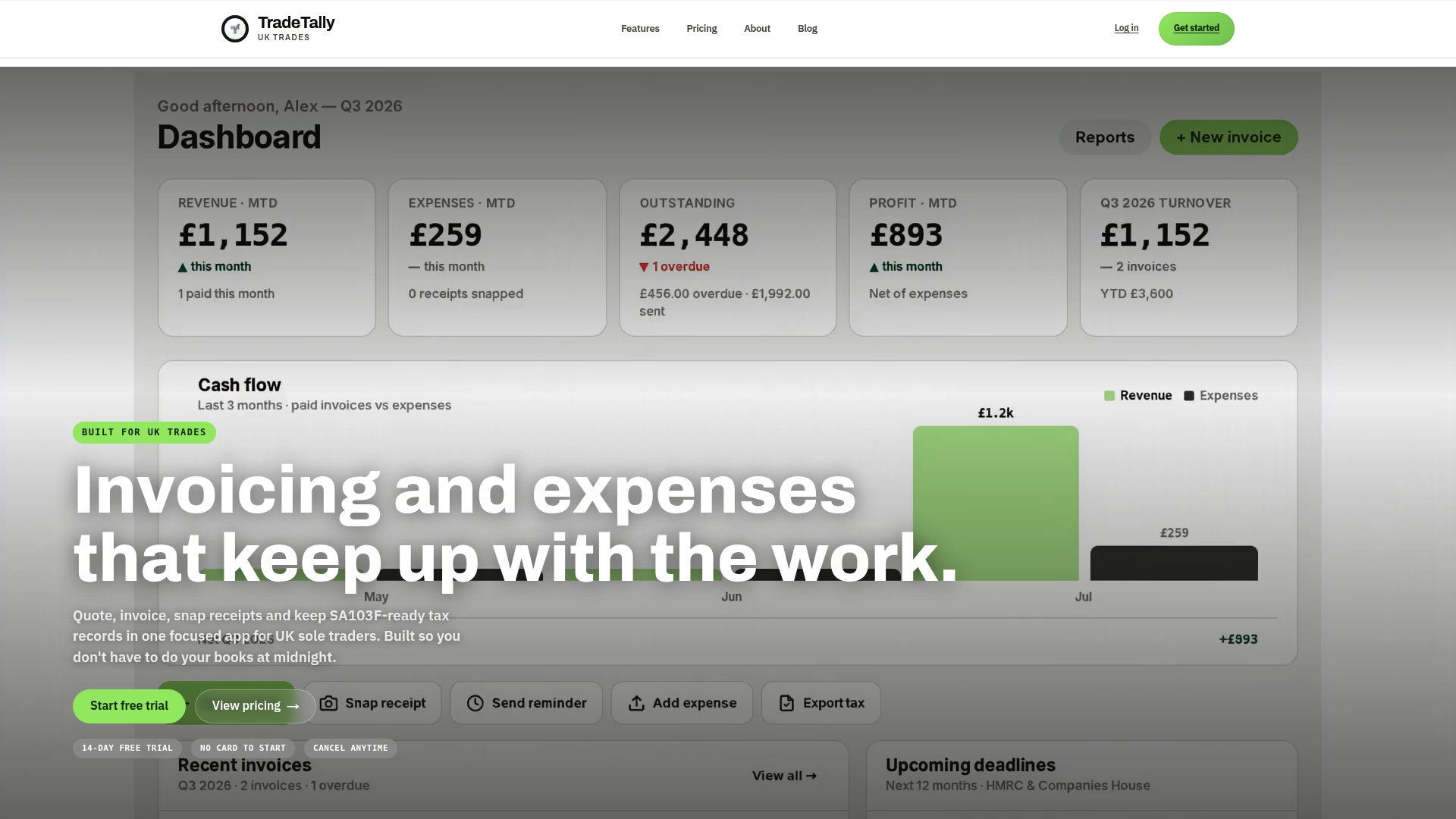
TradeTally is a UK web and mobile app for sole tradespeople that brings together quote creation, branded invoicing, expense and receipt tracking and a live profit dashboard. It was built by a working tradesperson for the admin that follows a day on site, with mobile-first invoicing and receipt capture suited to doing paperwork from your vehicle.
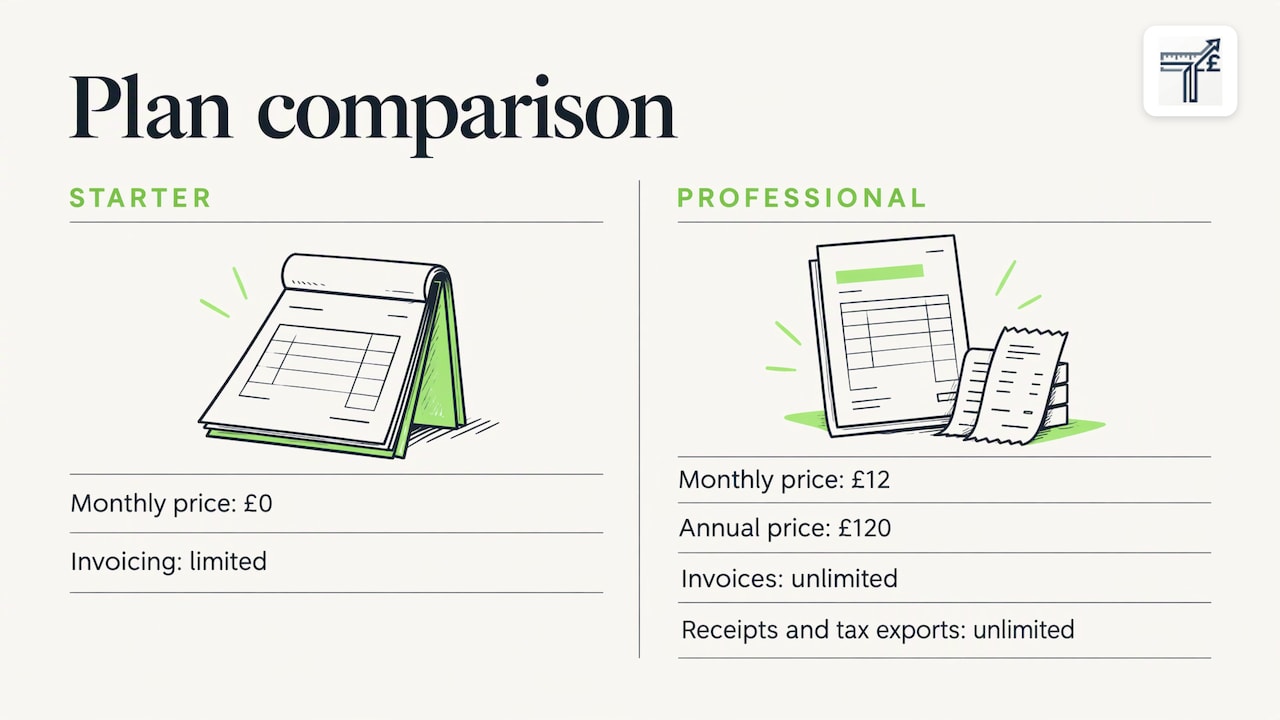
The Starter plan is £0 per month, with limited invoicing. The Professional plan is £12 per month or £120 per year, with unlimited invoices, receipts and tax exports. You can see both on the pricing page, or start from the TradeTally home page.
If you also invoice several clients at once, our system for multiple client invoicing shows how to keep each job’s quote, extras and payments from blurring together.
Our view on scope creep
We built TradeTally because the admin after a day on site is where jobs quietly lose money. The extra radiator, the second socket, the “just carry on” fence panel: none of it feels like a loss when it happens, and all of it shows up in the margin later.
Our view is simple. You do not fix scope creep by becoming difficult. You fix it by being clear early and consistent every time: a quote that says what is out as well as what is in, a price and a written yes before any extra, and a profit figure you can see while the job is still running.
That is why we put quoting, invoicing, receipts and a live profit dashboard in one mobile-first app. When the paperwork is quick to do from the van, it gets done, and a job you can see clearly is a job you can protect.
Simon
FAQ
What is another name for scope creep?
It is also called requirement creep or feature creep, and sometimes mission creep. On site, tradespeople usually just call it extras, or “while you’re here” jobs.
Is every extra request scope creep?
No. An extra that you have priced, agreed and recorded is a variation, and it is a normal part of the job. It only becomes scope creep when the work is done without agreement on cost, time or approval.
Should I put exclusions in a quote?
Yes. Name the specific things a client might reasonably assume are included, such as making good, waste removal or hidden defects, and put each beside the item it relates to. They matter most at the moment of disagreement, so they need to be specific.
Is a text message enough to approve an extra?
It is far better than a verbal yes, because it records the price and the agreement. For larger changes, a short signed note that names the extra work, the price and any change to dates is stronger. Keep it with the job’s other paperwork.
What if the client refuses to pay for the extra?
If the work was agreed in writing at a stated price, point to that record. If no price was agreed, the law only allows a reasonable charge. For a serious dispute, take advice from a solicitor or your trade body’s helpline.
Sources
- APM: What is scope creep and how can we mitigate it?
- PMI: Top five causes of scope creep and what to do about them
- CMI: How to avoid scope creep without damaging the client relationship
- Statements of Work for Agencies: exclusions and scope protection
- How can SMEs stop scope creep from reducing profit?
- Contracts.io: Scope creep and change control
- Scope creep management: protecting profitability
- Business Companion: Consumer Rights Act guidance for business
- Wrike: What is scope creep in project management?
Recommended
Related articles

Do Quotes Need Terms Included?
Do quotes need terms included? For UK sole traders, clear quote terms help avoid disputes, late payment and scope creep before work starts.

Keep Client Approvals for £150 Job Changes
Capture signed quotes, text approvals, and job changes from your van. Use simple scripts and exportable records that support HMRC and consumer law.

A Guide to Quoting Small Jobs Properly
A practical guide to quoting small jobs for UK sole traders. Price faster, protect profit, and send clear quotes clients accept with less hassle.

How to Quote Plumbing Jobs Properly
Learn how to quote plumbing jobs with clear pricing, labour, materials and margins so you win better work without undercharging.