Stop Payment Disputes: Quote vs Estimate for Tradespeople
Send a quote when you know the exact scope and are willing to be held to a fixed price. Send an estimate when details are still open, materials are unconfirmed, or you haven’t seen the job in person. A quote is legally binding once accepted; an estimate is not, but both must be written down and clearly labelled, or you’re the one left arguing about money later.
TL;DR:
- Providing a fixed quote requires a site visit, detailed scope, and includes an expiry date to prevent honoring outdated prices.
- An estimate is a range based on assumptions, not binding, and should specify triggers for revisions to avoid disputes.
- Use clear written documents with specific assumptions and valid dates to maintain transparency and prevent misunderstandings.
- Proper software tools help reduce quoting errors and streamline converting quotes into invoices and tax records.
- Always inspect thoroughly before quoting, and avoid giving fixed prices based on guesses to protect your margins and reputation.
Table of Contents
- Quote vs estimate: what’s the legal difference?
- What counts as an estimate?
- When should you give an estimate, and when a quote?
- What should a quote or estimate document actually contain?
- How do you calculate a price that actually holds up?
- How do you handle scope creep without losing the client?
- What wording should you actually use on the document?
- How does better software cut down on quoting mistakes?
- A tradesperson’s checklist for a day of quoting
- Why tradespeople get this wrong more often than they admit
- Sources
Quote vs estimate: what’s the legal difference?
A quotation is a fixed-price offer for a defined scope of work. Once your client accepts it, it becomes a contract, and you’re bound to deliver at that price even if your material costs rise or the job takes longer than planned. That’s the trade-off: certainty for the client, risk for you unless you’ve priced it properly. Quotes only make sense after you’ve seen the site, taken measurements, and know what you’re pricing, according to MyJobQuote.
A proper written quote should include:
- The full scope of work, described in plain terms
- An itemised breakdown of labour and materials
- A start date and realistic timescale
- A validity or expiry date (commonly 30 days)
- Payment terms, including deposit and stage payments
- A clause covering what happens if the client requests changes
Industry guidance from Nibusinessinfo is blunt about the expiry date: without one, you could be stuck honouring a six-month-old price on materials that have since gone up 15%. That single line protects your margin more than almost anything else in the document.
What counts as an estimate?
An estimate is your best professional judgement of cost based on what you know right now, and it’s not binding. Present it as a range rather than a single figure, because that range is what tells the client you’re being honest about the unknowns, not vague about the price.
A defensible estimate should set out:
- The assumptions behind the figure (materials, site access, condition of existing work)
- A price range, not a single number, where uncertainty is genuine
- What could trigger a revised figure, such as hidden damp or rotten joists
- A note that the final price will be confirmed once scope is fixed
The Dispute Resolution Ombudsman recommends estimates account for worst-case scenarios where relevant, rather than the best-case number that gets a job booked but blows up two weeks in. Present the range with a short line explaining why it’s a range. That one sentence does more to prevent arguments than any small print at the bottom of the page.
When should you give an estimate, and when a quote?
Use this checklist before you commit to either document:
- Scope certainty. Have you physically inspected the job, or are you working from a phone description?
- Client commitment. Are they comparing prices from three tradespeople, or ready to book?
- Project complexity. Is there anything hidden (old wiring, structural work, below-floor plumbing) you can’t verify without opening something up?
- Procurement stage. Is this an early enquiry or a formal tender requiring a fixed figure?
The rule of thumb most experienced tradespeople use: if you’ve taken measurements and seen the site, give a quote. If there’s anything below a floor, behind a wall, or dependent on someone else’s work, give an estimate first.
Mislabelling documents is where most disputes start. Calling a rough figure a “quote” over text message, then trying to revise it once you’re on site, is the single fastest way to lose a client’s trust, and in some cases, lose the argument over payment entirely.
Pro Tip: Never send pricing by text without a follow-up in writing. A quick email or app-generated PDF labelled “Estimate” or “Quotation” takes thirty seconds and removes almost all ambiguity later.
What should a quote or estimate document actually contain?
Both documents need structure, but the details differ. Here’s what belongs in each.
Quote checklist:
- Client name, job address, and date issued
- Itemised labour costs (hours × rate)
- Itemised materials with supplier or brand where relevant
- Clear exclusions (what’s not covered)
- Payment terms and deposit requirement
- Validity period, clearly stated
Estimate checklist:
- Stated assumptions (access, existing condition, materials pricing at time of writing)
- A price range with the midpoint clearly the “expected” figure
- Contingency allowance, usually a percentage on top
- Named triggers for a re-quote (e.g. “if timber is found to be rotten beyond the visible area”)
Put assumptions in writing, not as a verbal caveat during the site visit. If a client later disputes a revised price, a written assumption you can point back to is worth far more than “I did mention that at the time.” Homebuilding & Renovating makes the same point: transparency on assumptions up front heads off almost every payment argument down the line.
How do you calculate a price that actually holds up?
Start from real numbers, not gut feel.
- Calculate your hourly labour rate, including travel time and non-billable admin.
- Cost materials at current supplier prices, not what you paid six months ago.
- Add a contingency buffer, typically 10 to 20% for a well-prepared estimate, according to Beancount’s guide on estimating for small trades.
- For quotes, price firmly, because you can’t revise upward once it’s accepted.
Worked example: 16 hours labour at £35/hour = £560. Materials at £340. For a fixed quote on the same job, you’d price at the higher end and absorb small variances yourself.
Lowballing a quote to win the job is the fastest way to work for free in month two of a project. Price the risk in, or don’t give a fixed figure at all.
How do you handle scope creep without losing the client?
Scope creep is where estimates and quotes both get tested. The fix is a paper trail, not a difficult conversation on site.
- Issue a written change order for anything outside the original scope, and get sign-off before starting the extra work.
- Include an out-of-scope fee or hourly rate for extras in your original document, so there’s no negotiation mid-job.
- Cap free revisions at one or two before charging for further changes.
- If an estimate looks like it’ll be exceeded by more than your stated contingency, flag it to the client before continuing, not after the invoice lands.
This is also where an estimate quietly becomes a quote: once you’ve confirmed the real scope on site, convert it into a fixed price document rather than leaving the client guessing which figure is final.
What wording should you actually use on the document?
Label documents in plain English at the top: “Estimate, valid until [date], based on the following assumptions” or “Quotation, valid for 30 days from [date], fixed price for the scope below.” Neither phrase is complicated, but very few tradespeople actually write them down.
- State assumptions as a short numbered list directly under the estimate heading.
- Put the expiry date near the price, not buried in terms and conditions.
- Add one line on how change orders will be handled and charged.
Rather than building this from scratch every time, TradeTally’s free invoice and quote templates already carry this structure, so the labelling and expiry fields are there before you start typing.
How does better software cut down on quoting mistakes?
Most quoting disputes come down to two things: nothing was written down, or the document wasn’t clear about what it was. A structured template fixes both in seconds rather than through an argument later.
- Instant invoicing turns an accepted quote straight into a payable invoice, so nothing gets lost between the two.
- Receipt capture keeps material costs tied to the job, which makes future estimates on similar work far more accurate.
- SA103F export means the pricing detail you’ve already logged doubles up as tax-ready records come January.
Tools like TradeTally’s mileage calculator and tax and CIS calculators also help you price travel and deductions accurately into a quote, rather than guessing and eating the cost yourself.
A tradesperson’s checklist for a day of quoting
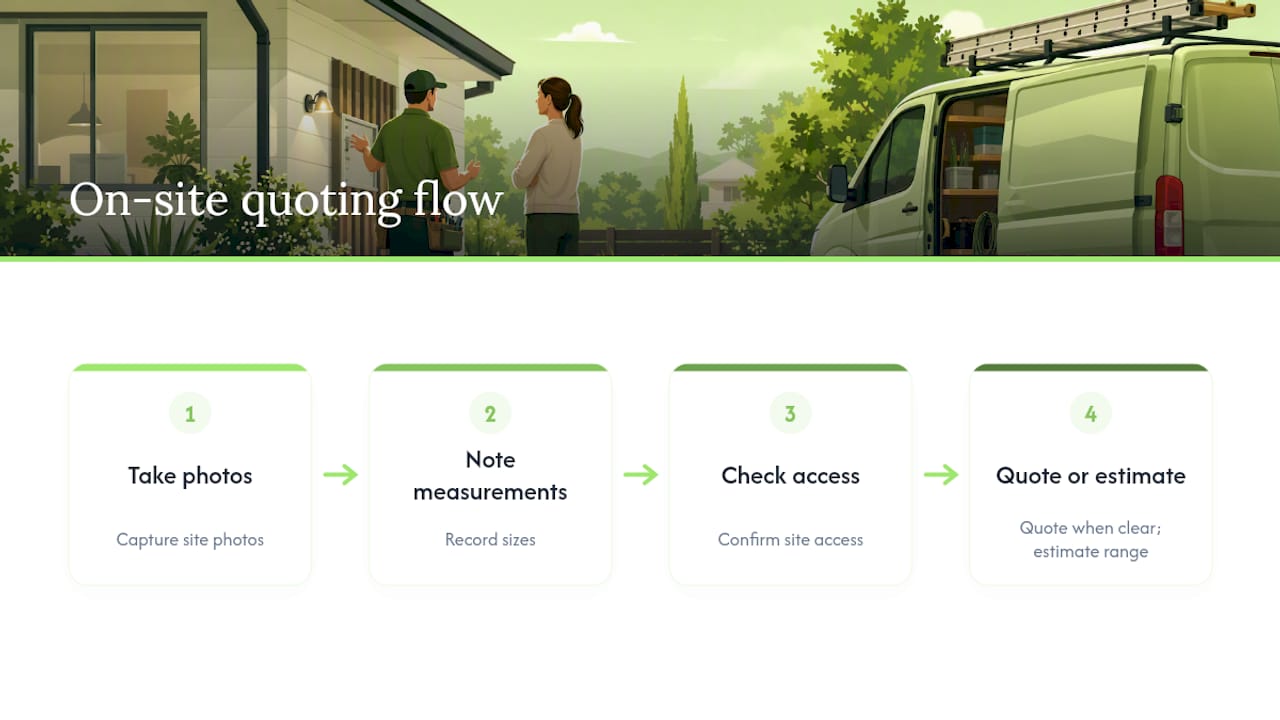
On site: take photos, note measurements, and check access before you open your mouth about price. If scope is clear, book a quote for later that day. If anything’s hidden, say so and send a written estimate with a range.
The pitfall I see most often: a verbal “rough figure” given to close the conversation, then treated by the client as a fixed price weeks later. It never was one, but nobody wrote that down.
Ready to stop chasing paperwork after every job? TradeTally’s carpenter invoicing tools and trade-specific pages turn your quotes straight into invoices and tax-ready records, without the evening admin session.
Why tradespeople get this wrong more often than they admit
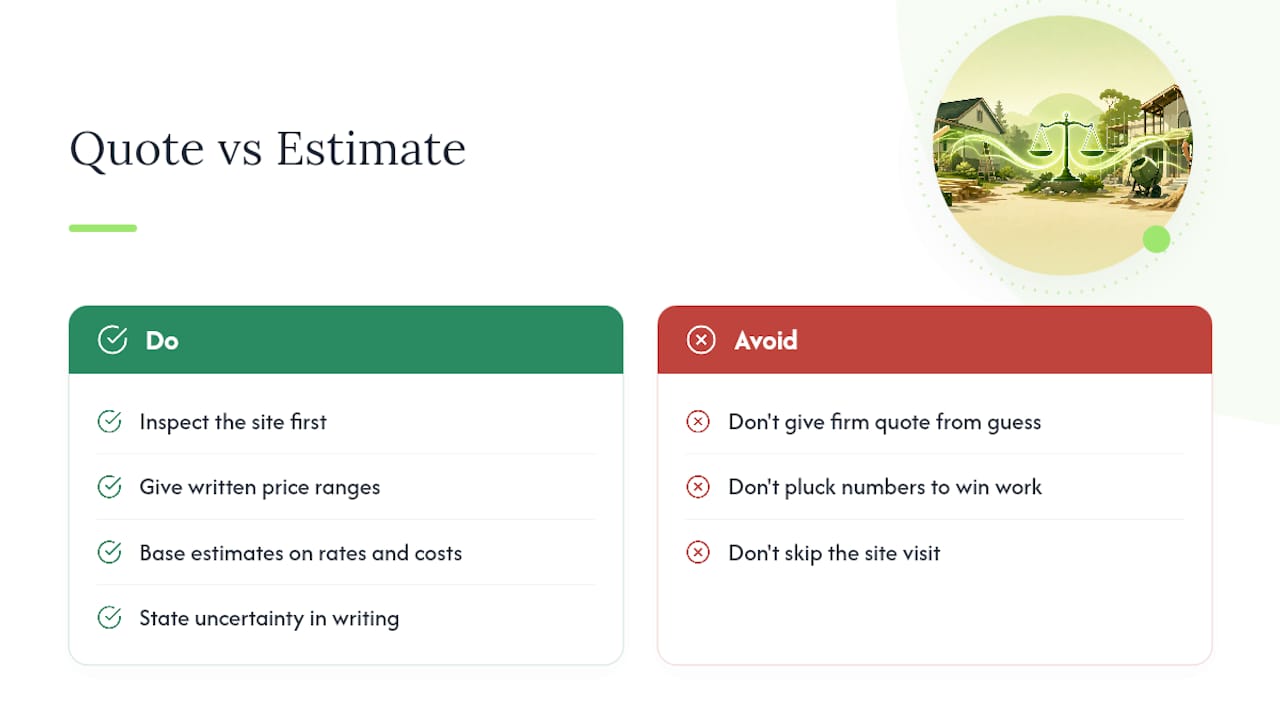
The mistake isn’t usually pricing. It’s confidence dressed up as precision. A lot of tradespeople give a fixed quote on a job they haven’t actually inspected properly, because saying “let me have a proper look and get back to you” feels like it might lose the work. It doesn’t, not to a client worth having. What loses work, and money, is quoting firm on a guess and then having to go back cap in hand for more once the floorboards come up.
The industry’s own guidance backs this: a quote only works when you’ve done the legwork first, and an estimate only holds up when it’s built from real hourly rates and material costs, not a number plucked to sound competitive. Software can enforce the discipline, but it can’t replace the site visit. If you’re not certain, say so in writing, put a range on it, and move on. That’s not weakness. It’s the only version of “quick quote” that doesn’t come back to bite you three weeks into the job.
— Simon
Sources
Recommended
Ready to sort your trade admin?
TradeTally gives UK sole traders invoicing, expenses, and SA103F-ready tax exports in one mobile-first app.
Start 14-day Pro trial →No card required