Capital Allowances for Sole Traders: A Practical Guide

Capital allowances are how a sole trader gets tax relief on big purchases such as tools, machinery and vehicles. Instead of deducting the cost as an ordinary expense, you claim an allowance against your profits on your Self Assessment return. Whether you claim them at all depends on how you do your accounts, and the claim is only as good as your records. Keeping every receipt, date and private-use split in one place from day one is what makes it painless, and that is what TradeTally is built for.
TL;DR
- Capital allowances give tax relief on equipment, machinery and vehicles you keep to use in the business. They reduce your taxable profit, not your tax bill directly.
- The Annual Investment Allowance (AIA) lets you deduct up to £1 million of qualifying purchases in the year you buy them. It does not cover cars.
- If you use the cash basis, most equipment is simply claimed as an expense. Capital allowances then matter mainly for cars.
- Anything you use partly for private purposes must be reduced by the private share, so you need a clear record of how each item is used.
- Keep the invoice, the date and the supplier for every purchase. A claim you cannot evidence is a claim HMRC can challenge.
Table of Contents
- What capital allowances are, in plain terms
- Capital allowances or a normal expense? Check your accounting basis first
- What you can and cannot claim on
- The Annual Investment Allowance
- Writing down allowances: the pools
- Cars, vans and private use
- What happens when you sell or stop using an asset
- How to claim, step by step
- Why your records decide the claim
- Perspective
- Keeping it all in one place with TradeTally
- FAQ
- Sources
What capital allowances are, in plain terms
When you buy a van, a laser level or a new set of power tools, you generally cannot deduct the cost like you would a box of screws. These are items you keep and use for years. Under traditional accounting, HMRC’s guidance says you do not deduct the purchase cost or depreciation. You claim capital allowances instead, taking them off your profit to find your taxable profit, or adding them to a loss.
HMRC describes capital allowances as a type of tax relief that lets you deduct some or all of the value of an item from your profits before you pay tax. The items are called plant and machinery, which in practice means the equipment, machinery and vehicles you use to do the job.
A simple example. You make £40,000 profit before allowances and buy £5,000 of qualifying equipment. If the whole £5,000 is claimed as an allowance in that year, your taxable profit becomes £35,000. You pay tax on the lower figure.
The thing that catches people out is the cost itself. The allowance is not a refund. It reduces the profit you are taxed on, so the saving depends on your tax rate. That is why tracking each purchase properly matters more than the headline allowance figure.
Capital allowances or a normal expense? Check your accounting basis first
Before you claim anything, work out which route applies to you. This is the step that decides whether the rest of this article matters for your return.
Traditional accounting. You claim capital allowances when you buy equipment, machinery or business vehicles. HMRC’s page on self-employed expenses sets this out, and also says you cannot claim capital allowances if you use the £1,000 tax-free trading allowance. Small day-to-day items are allowable expenses rather than capital items, and HS252 confirms you cannot claim capital allowances on any cost you can claim as an expense.
Cash basis. Under the cash basis, the same HMRC page says capital allowances can be claimed on a business car, while other items are claimed as allowable expenses. So a tradesperson on the cash basis who buys a £900 hammer drill kit simply puts it through as a business expense. Cars are the exception.

Many sole traders will be on the cash basis, and it can smooth out the March to April tax shock when income arrives late. We cover how that works in our guide to cash basis accounting for UK trades.
Pro tip: do not guess which basis you are on. Look at last year’s Self Assessment return, or the box you ticked when you set up. Then record every purchase the same way all year, so nothing has to be reclassified in January.
What you can and cannot claim on
HMRC’s guidance says you can claim on items you keep to use in your business. For a tradesperson that typically includes:
- Equipment and machinery, such as larger power tools, compressors, scaffolding towers and testing equipment
- Business vehicles
- Integral features of buildings and some fixtures, such as fitted kitchens
- Alterations needed to install qualifying equipment
HMRC’s what you can claim on page also lists what is excluded: items you lease (unless it is hire purchase or a long funding lease), items bought only for business entertainment, and land, structures and buildings.
Plant and machinery allowances also do not cover stock. The materials you buy for a job are a normal cost of the work, not a capital item.
As a rule of thumb, usually anything with a useful economic life of at least two years may qualify. Consumables, small hand tools and work clothing are generally everyday expenses instead. Our guides on allowable tools expenses, claiming tools and equipment and the full list of HMRC allowable expenses for tradespeople help you sort which side of the line each purchase falls on.
The Annual Investment Allowance
The AIA is the relief most sole traders on traditional accounting will use. HMRC states the amount is £1 million: you can deduct the full value of a qualifying item from your profits before tax. For a sole trader that is effectively the whole of any realistic equipment spend, so most qualifying purchases are relieved in the year of purchase.
Three rules to know:
- You claim it only in the period you bought the item. If you skip it that year, you cannot go back and claim the AIA later. HMRC’s page says you can only claim it in the period you bought the item.
- It does not cover cars. HMRC says you cannot claim AIA on business cars, on items you owned for another reason before business use, or on gifted items. Writing down allowances apply to those instead.
- The limit is scaled for short or long periods. The £1 million applies to a 12-month accounting period. UK Property Accountants points out that the figure is reduced for periods shorter than 12 months, which can catch new businesses in their first year, or anyone who changes their accounting date. A six-month period, for example, gives £500,000.
The same source notes that in a low-profit year it can pay to claim only part of the AIA and leave the rest in the pool to be written down in later, higher-profit years. If your profit is already covered by your personal allowance, claiming the full amount may waste relief you could have used later. That is a decision worth talking through with your accountant, because it depends on your whole income.
Writing down allowances: the pools
Whatever is not covered by the AIA goes into a pool, and you claim a percentage of the pool’s balance each year. HMRC’s HS252 helpsheet explains there are three kinds:
- Main pool: most equipment.
- Special rate pool: integral features, long-life assets (25 years or more), higher-CO2 cars, solar panels and thermal insulation.
- Single asset pools: assets used partly privately, and short-life assets.
The HS252 helpsheet for 2026 gives the rates it applied as 18% for the main pool and 6% for the special rate pool. The main rate has since changed. In the Commons committee debate on the Finance (No. 2) Bill, the Economic Secretary to the Treasury described the main rate falling from 18% to 14%, effective for income tax from 6 April 2026. For 2026/27, a sole trader’s main pool therefore writes down at 14% a year on a reducing balance, with the special rate pool at 6%.
The new 40% first-year allowance
From 1 January 2026 there is also a 40% first-year allowance. HMRC says it applies to plant or machinery that is new and unused, qualifies for the main rate of writing down allowance and is not a car. The remaining 60% of the cost goes into the pool. For most sole traders the AIA will already give 100% relief, so the 40% allowance matters mainly if your spending in a year goes well beyond the AIA limit.
Cars, vans and private use
Vehicles are where most tradespeople’s claims go wrong, so take them slowly.
Cars cannot attract the AIA, full expensing or the first-year allowances. HMRC’s common-errors guidance for plant and machinery claims confirms none of those can be claimed on cars. Cars go into a pool and are written down over the years.
Private use must be taken off. For sole traders, HMRC treats your own personal use as non-qualifying use. The asset goes into its own single asset pool and the claim is reduced by the percentage of private use. The AIA page gives a simple illustration: a £600 laptop used half the time privately gets a 50% reduction.
HMRC’s worked example for a car on the writing down allowances page shows the mechanics. The pool starts at £10,000, and at the 14% rate used in that example the allowance is £1,400. The car is used half the time for family, so only £700 is claimed. The full £1,400 still comes off the pool, leaving £8,600.
The lesson for your records: you need to know, for every vehicle and every mixed-use item, what proportion of use is business. A rough guess at the end of the year is exactly what HMRC lists among common errors. If you drive for work, a mileage log is the evidence. Our guides on vehicle expenses for sole traders and the HMRC mileage allowance explain how vehicle costs are handled, and our piece on splitting personal and business expenses shows how to separate mixed purchases at the point of buying.

What happens when you sell or stop using an asset
Capital allowances are not a one-way street. HMRC’s HS222 helpsheet notes that a balancing charge may arise when an asset is sold, given away or no longer used in the business. In plain terms, if you have already claimed relief on something and then sell it, some of that relief can be taken back. Record the date and sale price of any significant equipment you dispose of, and tell your accountant when you do.
How to claim, step by step
- Confirm your accounting basis. Traditional accounting means capital allowances for equipment. Cash basis means expenses for equipment and allowances for cars.
- Gather the purchase evidence. For each item you need the invoice, date, supplier and amount.
- Sort capital items from everyday costs. Tools that last years may be capital. Consumables and small items are normal expenses.
- Work out the private-use share for any vehicle, phone, laptop or tool you also use outside work.
- Decide how much AIA to claim. Usually all of it, unless a low-profit year makes it better to save some for later.
- Put the figures in the right place on your Self Assessment return, with any pooled balances carried forward.
- Keep the records. UK Property Accountants advises keeping purchase invoices for five years from the 31 January filing deadline for the relevant tax year.
Step 6 is where many people reach for an accountant, and that is sensible for pooled balances or a large purchase. The more tidy your records, the less time that takes.
Why your records decide the claim
The rules above are not difficult. What goes wrong is the paperwork: a receipt left in the van door pocket, a purchase date nobody can find, or a car with no log of business use.
Three habits fix most of it:
- Photograph the receipt on the day. Paper fades and the supplier’s online account may close.
- Note the use at the time of purchase. Is it a business-only item, or mixed?
- Keep one running list of items over two years’ life. That list is your asset register, and it is the first thing your accountant will ask for.
Perspective
Most of the tax stress we hear about from tradespeople is not about the rules. It is about trying to rebuild a year of purchases from bank statements in January.
We built TradeTally because the admin that follows a day on site should take minutes, not an evening. You snap the receipt from the van, it is logged against the job, and your expenses and tax-ready records are there when the return is due. The Self Assessment export is formatted for SA103F, so what you hand over to your accountant, or use yourself, is already in the shape the return needs.
Capital allowances reward the person who knows exactly what they bought, when, and how it is used. That is a records problem before it is a tax problem. Get the records right and the claim follows.
Simon
Keeping it all in one place with TradeTally
If you buy equipment and vehicles through the year, the easiest way to be claim-ready is to record purchases as you make them. TradeTally is a UK web and mobile app for sole tradespeople that handles invoicing, quotes, expense and receipt tracking, mileage and time tracking, and CIS deductions, with MTD-ready record-keeping and exports for Self Assessment and accountant handoff.
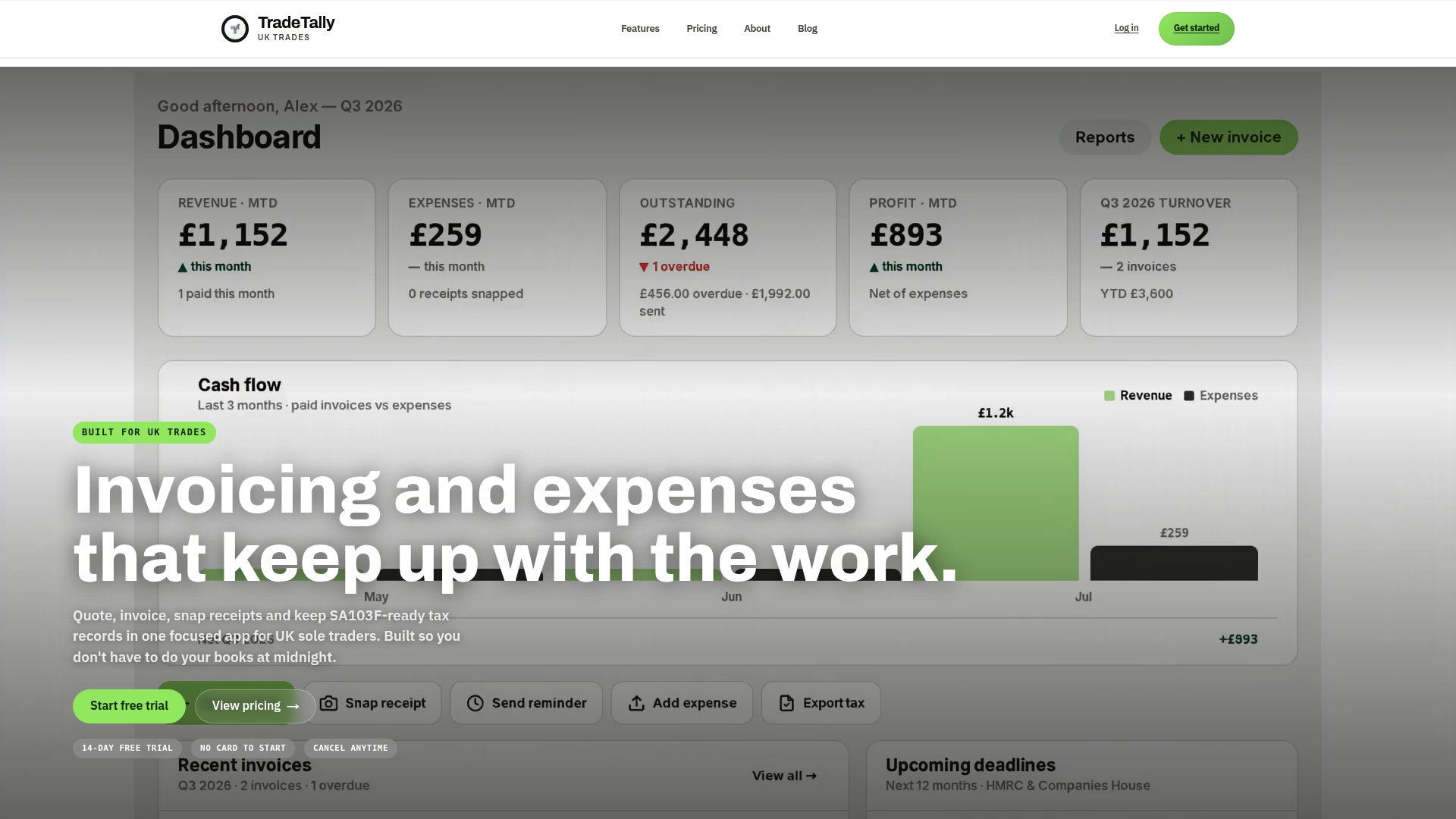
The Starter plan is free at £0 a month, with limited invoicing. Professional is £12 per month, or £120 per year, for full access to unlimited invoices, receipts and tax exports. You can see both on the TradeTally pricing page, or start from the TradeTally home page.
FAQ
Can a sole trader claim capital allowances?
Yes. HMRC lists the self-employed among those who can claim plant and machinery allowances. You claim through your Self Assessment return, provided you are not on the cash basis for that item or using the £1,000 trading allowance.
What is the annual investment allowance for a sole trader?
It is a 100% deduction on qualifying plant and machinery, up to £1 million in a 12-month accounting period. You claim it in the period you buy the item. It does not apply to cars, and the limit is scaled for periods shorter or longer than a year.
Is capital expenditure taxable?
The money you spend on equipment is not deducted as an ordinary expense under traditional accounting. Instead, you claim capital allowances, which reduce your taxable profit. If you later sell an item you have claimed on, a balancing charge may arise.
Do I claim capital allowances on a van or car?
Cars cannot attract the AIA, and are claimed through pools with writing down allowances, reduced for any private use. The type of vehicle matters, so check HMRC’s guidance on the vehicle you use, and keep a log of business mileage to support the business-use share.
Sources
- Claim capital allowances: Overview, GOV.UK
- Claim capital allowances: What you can claim on, GOV.UK
- Claim capital allowances: Annual investment allowance, GOV.UK
- Work out your writing down allowances, GOV.UK
- Expenses if you’re self-employed, GOV.UK
- HS222 How to calculate your taxable profits (2025), GOV.UK
- HS252 Capital allowances and balancing charges 2026, GOV.UK
- Common areas of error in claims for plant and machinery allowances, GOV.UK
- Clause 28, Finance (No. 2) Bill Public Bill Committee, 27 January 2026
- Annual Investment Allowance (AIA): Who Qualifies and How to Claim
Recommended
Related articles

Allowable Tools Expenses for UK Sole Traders: What You Can Claim
Which tools can a UK sole trader claim as expenses? Cash basis v capital allowances, repairs v replacements, private use and the records HMRC expects.

Vehicle Expenses for Sole Traders
UK tradespeople who are sole traders: learn when 55p per mile or actual costs pays off, how VAT and capital allowances work, and how to keep tax-ready...

Fuel vs Mileage Claims: Which Is Better for Sole Traders?
Fuel receipts or the 55p mileage rate? See what UK sole traders can claim, why you can't do both on one vehicle, and how to choose with a worked example.

How to Record Van Expenses Without Tax-Time Panic
Learn how to record van expenses, split business and private use, save receipts and keep clean UK sole trader records ready for Self Assessment each year.